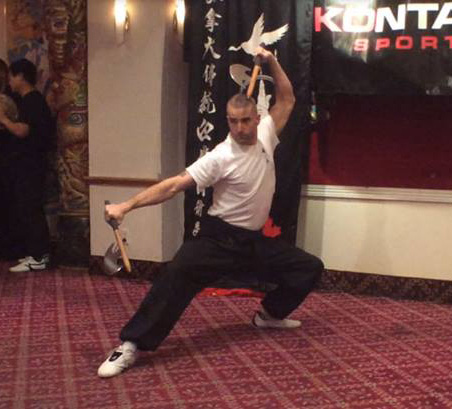
Training with traditional Chinese weapons. Why?
I have always been fascinated by swords, axes and all types of close combat weapons. Lucky for me, our White Crane style has a wide variety of weapons available in the system. Many, only see the first layer of the appeal of course: it makes you feel like your favorite barbarian, kung fu hero or video game character. Some may question how training with a sword or halberd could be relevant in modern society. Is it simply a playful warrior fantasy or is there a point to it?
First off, let’s look at the physical benefits. With the rise of social media, we have seen an increase in the sharing of ancient training methods and movement discipline that used to be isolated. You can easily find a multitude of people sharing Indian club routines, Persian meel, steel mace, kettlebells, etc. China too has a rich tradition of physical conditioning using various objects including weighted weapons, stone locks, iron rings, and more.
Training with traditional Chinese weapons blends physical conditioning and practical motor skill development wrapped into a holistic practice that enhances balance, coordination, and situational awareness beyond what empty-hand training alone can offer.
Weapons forms teach precise timing, distance management, power generation and biomechanics that transfer to everyday movement and self-defence. Learning how to properly channel power to the impact point of a weapon helps greatly in understanding and applying those principles to empty hand techniques.
Beyond the physical, you will find there are some mental benefits to the practice as well. When you start adding speed to your weapon routines, the focus required to move with precision and confidence to execute the techniques safely brings benefits beyond the martial and physical. Having to wield a seven-foot halberd or spinning a weighted dart on a length of chain around your head requires concentration and a certain amount of courage. The discipline required to master complex movement patterns nurtures patience, focus, and confidence, all assets that will have a positive impact in your professional and personal life.
Weapons training can be a form of movement meditation offering a safe, structured outlet for excess energy, and stress release, promoting mental resilience and health.
When training partnered sets or drills you develop a sense of camaraderie by building trust and mutual respect with your training partners.
Even when learning to wield archaic or exotic weapons you develop attributes relevant to self-defence. By learning how to handle various close combat weapons, of course you become more proficient at wielding those specific implements. But training with weapons of various shapes and sizes allows you to understand how everyday objects can be used as weapons in self-defence situations.
When faced with a dangerous altercation, being able to utilize whatever your environment has to offer to gain some type of advantage is an important benefit of weapon training.
There are also other, more subtle reasons to the train in the art of traditional weapons. The practice of forms from traditional arts also sustains a connection to history, philosophy, and craftsmanship, providing a connection to cultural heritage and an appreciation for tradition in a world of rapid technological change. With this practice you have a chance to understand the context of where they came from and how they were used. Also, by practicing those ancient forms we encourage the need to perpetuate the knowledge and craftsmanship required to make the weapons, and if one has the interest, it is an opportunity to develop your own level of craftsmanship in properly maintaining your weapons.
Perpetuating those traditions allows us to slow down the pace, connect with ancient roots and allows us to preserve those traditions as a gift for future generations.
And after sharing this reflection on the subject, my thoughts come full circle. Swinging a pair of battle axes feels pretty darned cool!